
-
 garym
- August 7, 2026
 garym
Corrugated Flute Guide: Understanding E, B, C, A & Double-Wall Cardboard for Better Packaging
When choosing cardboard packaging, it is easy to focus on the box size, printing and price. But one of the most important decisions happens inside the board itself: the flute profile.
The flute is the corrugated, wave-shaped layer between the paper liners. Its height, construction and combination with other flutes influence the box’s thickness, rigidity, cushioning, stacking performance and printability.
Choosing the right flute can make a significant difference to your packaging. The wrong specification can result in damaged products, crushed boxes, unnecessary material costs or packaging that is simply more expensive than it needs to be.
At Centrapak 360, we help businesses select packaging based on the product, application, supply chain and budget — rather than simply recommending the thickest cardboard available.
What Is Corrugated Cardboard?
Corrugated cardboard, also known as corrugated fibreboard, is made from layers of paper.
A typical single-wall board consists of:
An outer liner
A fluted corrugated medium
An inner liner
The fluted medium creates a series of arches between the liners. These arches provide structural support while also creating air space that can help with cushioning and protection.
For heavier or more demanding applications, two fluted layers can be combined between three liners. This is known as double-wall corrugated board.
The result is a lightweight material with an excellent strength-to-weight ratio, making corrugated board suitable for everything from retail packaging and e-commerce boxes to industrial and export packaging.
What Is a Corrugated Flute?
The flute is the wavy layer of paper inside corrugated board.
Different flute profiles have different heights and flute frequencies. Generally, a taller flute provides more cushioning and vertical structure, while smaller flutes can provide a thinner, more rigid board with a smoother printing surface.
Common flute profiles include:
| Flute | Approx. thickness* | Typical characteristics |
|---|---|---|
| A-Flute | ±4.5–5 mm | Excellent cushioning and stacking |
| C-Flute | ±3.5–4 mm | Strong all-round shipping performance |
| B-Flute | ±2.5–3 mm | Good crush resistance and printability |
| E-Flute | ±1.2–1.8 mm | Thin, rigid and excellent for printing |
| F-Flute | ±0.8–1 mm | Micro-flute for premium applications |
| BC Double Wall | ±6–7 mm | High strength and protection |
| EB Double Wall | ±4–5 mm | Strength combined with a finer print surface |
*Actual board thickness varies according to manufacturer, paper grades and construction.
These figures should therefore be used as general guides rather than fixed specifications.
A-Flute: Maximum Cushioning

A-flute is one of the larger corrugated flute profiles.
Its greater flute height creates more space between the liners, providing good cushioning and impact absorption.
A-Flute is suitable for:
Fragile products
Heavy products requiring cushioning
Protective packaging
Industrial applications
Products requiring additional impact protection
A-flute can be particularly useful where the packaging needs to absorb shocks during handling and transportation.
However, the greater thickness also means that A-flute packaging takes up more space than thinner flute options.
C-Flute: The Versatile Shipping Choice

C-flute is widely used for general shipping and transport packaging because it provides a good balance between strength, cushioning, thickness and cost.
It is often used for standard transport cartons, distribution packaging and palletised goods.
C-Flute is suitable for:
General shipping cartons
E-commerce packaging
Food and beverage packaging
Warehouse cartons
Distribution packaging
Products requiring moderate cushioning
Palletised shipments
C-flute is a strong general-purpose option, but it is not automatically the best choice for every product.
For example, a lightweight retail box that requires high-quality graphics may benefit from E-flute or B-flute instead.
B-Flute: Strength With a Lower Profile
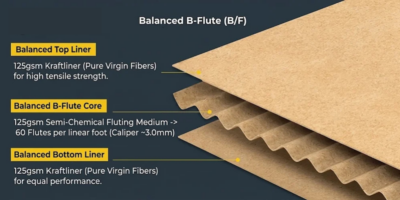
B-flute is thinner than C-flute and has a relatively flat, stable surface.
It offers a useful combination of crush resistance, structural rigidity and printability, making it popular for many retail and transport applications.
B-Flute is suitable for:
Retail packaging
Consumer products
Food packaging
Beverage packaging
Dividers and inserts
E-commerce boxes
Medium-duty transport packaging
B-flute can be an excellent choice where you need more structure than E-flute but don’t necessarily require the thickness of C-flute.
E-Flute: Thin, Lightweight and Print-Friendly
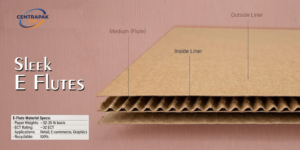
E-flute is considerably thinner than B- and C-flute.
Its fine profile creates a relatively smooth surface, making it particularly attractive for branded retail packaging, presentation boxes and lightweight products.
E-Flute is suitable for:
Cosmetics
Small electronics
Retail products
Premium product packaging
Lightweight e-commerce packaging
Printed presentation boxes
Product sleeves and speciality packaging
One of the biggest advantages of E-flute is that it provides some of the protective characteristics of corrugated packaging while maintaining a relatively slim profile.
What Is Double-Wall Corrugated Board?
Sometimes a single layer of corrugated board isn’t enough.
Double-wall corrugated board combines two fluted layers with three liners.
For example:
BC Double Wall = B-Flute + C-Flute
The two flute profiles work together to create a thicker and stronger board.
Double-wall construction is commonly used when packaging must withstand higher loads, greater stacking pressure or more demanding transportation conditions.
Double-wall packaging is suitable for:
Heavy products
Machinery components
Industrial products
Large cartons
Export packaging
Palletised products
Long-distance transportation
Products requiring additional protection
At Centrapak 360, double-wall solutions can also be considered as an alternative to traditional wooden crates for certain applications, depending on the product weight, handling method and transport requirements.
BC vs EB Double Wall
Not all double-wall board is the same.
BC Double Wall
BC combines B-flute and C-flute.
It provides a strong combination of:
Stacking strength
Cushioning
Rigidity
Protection
BC is often suitable for heavier transport and industrial packaging.
EB Double Wall
EB combines E-flute and B-flute.
This creates a thinner double-wall structure than BC while still providing additional strength compared with a single-wall board.
The finer E-flute can also provide a better surface for printing on the appropriate side.
Which one is better?
There is no universal answer.
The correct option depends on:
Product weight
Product fragility
Box dimensions
Stacking height
Transport method
Storage conditions
Printing requirements
Board grade
How Do You Choose the Right Flute?
Choosing a flute shouldn’t simply be a matter of saying:
“Heavier product = thicker cardboard.”
There are several factors to consider.
1. Product Weight
The heavier the product, the greater the structural requirements of the packaging.
However, weight alone doesn’t determine the board specification.
A compact 15 kg product may require a different solution from a large, lightweight product because the box dimensions and load distribution are different.
2. Product Fragility
A fragile product may benefit from a flute that provides greater cushioning.
For particularly sensitive products, the solution may also involve:
Inserts
Dividers
Corner protection
Foam alternatives
Honeycomb protection
Internal fitments
The strongest outer box cannot compensate for poor internal protection.
3. Box Dimensions
Large boxes place greater demands on the board.
As the box becomes larger, the panels have greater unsupported areas and can become more susceptible to bulging, crushing and deformation.
This is why a large box may require a stronger construction even when the product itself isn’t particularly heavy.
4. Stacking Requirements
Will your boxes be:
Stored individually?
Stacked in a warehouse?
Palletised?
Transported by truck?
Exported by sea?
Stored for several weeks?
These questions matter.
A carton that performs perfectly as a single box may behave very differently when placed underneath several layers of cartons.
5. Printing and Brand Presentation
If the box is customer-facing, the print surface becomes important.
Generally, finer flute profiles such as E-flute and B-flute can provide a smoother appearance for detailed graphics.
For transport cartons where printing is mainly limited to logos, handling instructions, barcodes or shipping information, C-flute or double-wall constructions may be more appropriate.
Don’t Forget Board Grade
One of the most important points when specifying corrugated packaging is that flute type is only part of the specification.
Two boxes can use the same flute profile but have different performance characteristics because of the paper grades and liners used.
Board specifications can include measures such as:
ECT — Edge Crush Test
Burst strength
Paper grammage
Liner quality
Moisture resistance
Ply adhesion
This means that simply asking for a “C-flute box” does not provide enough information to guarantee a particular level of performance.
At Centrapak 360, we look at the complete packaging requirement rather than selecting a flute in isolation.
Single Wall vs Double Wall
A simple way to think about the difference is:
Single Wall
2 liners + 1 fluted layer
Best suited to many everyday packaging applications.
Double Wall
3 liners + 2 fluted layers
Provides additional structure and protection for more demanding applications.
However, thicker doesn’t always mean better.
If a product only requires E-flute, specifying BC double wall could increase packaging cost, storage volume and transport space unnecessarily.
The goal is to find the optimum board, not simply the thickest board.
The Cost of Choosing the Wrong Flute
Packaging can become expensive in two different ways.
Under-specification
The packaging isn’t strong enough.
This can lead to:
Crushed cartons
Product damage
Returns
Customer complaints
Repacking costs
Wasted stock
Damage during transportation
Over-specification
The packaging is stronger than necessary.
This can result in:
Higher material costs
Increased packaging weight
More warehouse volume
Higher transport costs
Excess material usage
The best packaging specification sits somewhere between the two.
Strong enough to protect the product — without paying for protection you don’t need.
Corrugated Flute Selection by Application
As a starting point, consider the following:
| Application | Potential flute options |
|---|---|
| Premium retail packaging | E / F |
| Small e-commerce products | E / B |
| General retail packaging | B / E |
| Standard shipping cartons | B / C |
| General warehouse packaging | C |
| Heavy transport packaging | C / BC |
| Industrial packaging | BC / heavier constructions |
| Large or heavy products | BC / double wall |
| Fragile products | A / C / double wall + internal protection |
| Export packaging | C / BC / specification-dependent |
These are starting points only. The final board specification should be based on the product and supply-chain requirements.
How Centrapak 360 Can Help
Choosing the right cardboard isn’t simply about finding the cheapest box.
At Centrapak 360, we take a complete view of your packaging requirements.
Our packaging solutions can include:
Consulting
We assess your current packaging and identify opportunities to improve protection, efficiency and cost.
Design & Prototyping
We can develop packaging concepts and samples before you commit to production.
Packaging Supply
From standard corrugated cartons to custom-designed packaging, we source solutions to suit your application.
Protective Packaging
We can look at internal protection, dividers, inserts and alternative materials where required.
Warehousing & Distribution
Packaging needs to work not only at the factory, but throughout your supply chain.
Cost Optimisation
The objective isn’t simply to reduce the price of the box. It is to optimise the total cost of packaging, handling, storage and transportation.
Final Thoughts: The Right Flute Makes a Difference
Corrugated cardboard may look simple, but the engineering behind it can have a major impact on packaging performance.
From E-flute for lightweight, premium retail packaging to C-flute for general shipping and BC double wall for demanding industrial applications, each construction has a role to play.
The right choice depends on much more than product weight.
Consider:
Product + box dimensions + fragility + stacking + transport + printing + board grade + cost.
When these factors are considered together, you can create packaging that protects your product without unnecessarily increasing your packaging spend.
Need help choosing the right cardboard?
Centrapak 360 provides complete packaging solutions — from packaging design and prototyping through to supply, protection and distribution.
Let us help you find the right packaging specification for your product.
Centrapak 360 — Packaging. Reinvented. 360° Solutions.
Frequently Asked Questions
What is the strongest corrugated flute?
There isn’t one flute that is automatically the strongest in every application. Larger flute profiles and double-wall constructions can provide greater structural performance, but the actual strength also depends on the paper grades, board construction, box dimensions and design.
Is C-flute better than B-flute?
Not necessarily. C-flute is generally thicker and provides good cushioning and stacking performance, while B-flute offers a thinner construction with good crush resistance and printability. The better choice depends on the application.
Is double-wall cardboard stronger than single-wall?
Double-wall construction generally provides greater structural strength and protection than comparable single-wall construction, but actual performance depends on the flute combination and paper grades used.
Which flute is best for printed packaging?
E-flute and F-flute can provide a relatively smooth surface for detailed graphics. B-flute is also commonly used where a balance between printing and structural performance is required.
How do I choose the right cardboard thickness?
Start with the product weight, fragility, box dimensions, stacking requirements, transportation method and printing requirements. Then select the appropriate flute and board grade.
Does thicker cardboard always mean better packaging?
No. Over-specifying the board can increase material, storage and transportation costs. Good packaging design aims to provide the required protection with the most efficient material specification.
Can Centrapak 360 help me select the right board?
Yes. Centrapak 360 can assess your product and packaging requirements and recommend a suitable packaging construction, including flute, board type, box design and protective components.