-
 mark1
- October 16, 2026
 mark1
Sustainability used to be a “nice to have” on a packaging brief. In South Africa today, it’s fast becoming a business requirement. Under Extended Producer Responsibility (EPR) regulations, the companies that put packaging on the market share responsibility for what happens to it after use.
If you manufacture, import, distribute or sell branded products, this can feel like one more thing to worry about. The good news? It’s very manageable when you take it step by step. Here’s what you need to know, and the practical packaging changes you can start making now.
This article is general guidance, not legal advice. Please confirm your specific obligations with your industry Producer Responsibility Organisation (PRO) or a compliance adviser.
What is EPR?
EPR is a policy approach that makes “producers” (generally brand owners, manufacturers and importers) responsible for funding and supporting the collection, recycling and recovery of their products and packaging.
In South Africa, the Extended Producer Responsibility Regulations, 2020, issued under the National Environmental Management: Waste Act, set out the framework. Producers in identified sectors, including paper, packaging and some single-use products, are expected to belong to or set up an EPR scheme, report on what they place on the market, and pay EPR fees.
Importantly, the regulations allow for fees that differ by product category and by factors such as weight and recyclability. Put simply: packaging that’s harder to recycle can cost more to put on the market.
Why it matters for your packaging decisions
EPR shifts packaging from a pure purchasing decision to a strategic one. Your choice of material, format and design can now affect:
- Compliance: meeting your obligations under the regulations.
- Cost: EPR fees and how they are calculated for your packaging types.
- Retail access: many large retailers and brand owners have their own sustainability commitments, and suppliers are increasingly asked about packaging recyclability.
- Brand reputation: consumers notice excessive or hard-to-recycle packaging.
Industry momentum is building too. The SA Plastics Pact’s 2030 targets include making 100% of rigid plastic packaging recyclable and 70% of flexible packaging recyclable. The Department of Forestry, Fisheries and the Environment (DFFE) has also published a Packaging Guideline: Recyclability by Design to help designers understand the environmental impact of their choices.
7 practical steps toward more recyclable packaging
1. Audit what you use today
List every packaging component you put on the market: primary packs, labels, cartons, shrink and pallet wrap, inserts and tapes. Note the materials and approximate weights. You can’t improve what you haven’t measured, and this data also supports your EPR reporting.
2. Cut what you don’t need
The most sustainable packaging is the packaging you don’t use. Look for oversized boxes, excess void fill and double layers that add no protection. Right-sizing often saves material, freight space and storage, so it’s a cost win as well as a sustainability one.
3. Simplify materials where possible
Mixed materials that can’t easily be separated are harder to recycle. Where performance allows, consider simpler structures, for example fibre-based options or flexible packs made from fewer different materials. Always test, though: a pack that fails in transit creates far more waste than it saves.
4. Choose recyclable and fibre-based options where appropriate
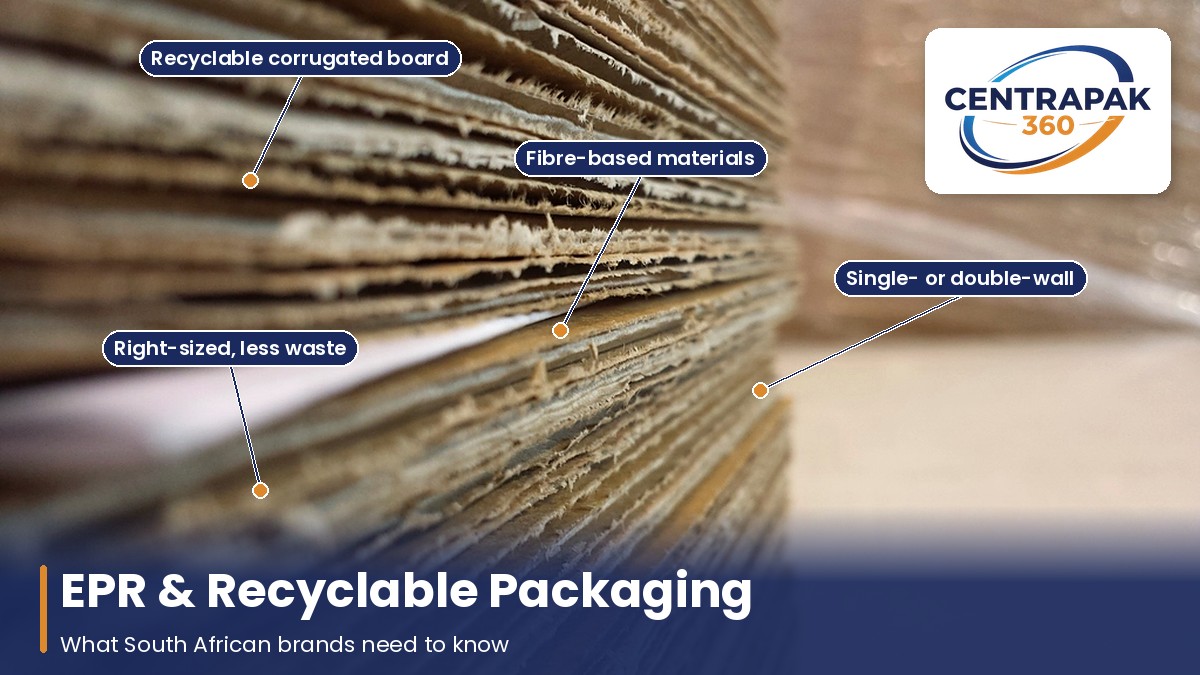
Corrugated and carton board are widely recycled in South Africa. Using recyclable board grades, and choosing the right flute and wall (single-wall or double-wall) for the job, can give you the protection you need without over-packaging. Our corrugated flute guide explains the options.
5. Design labels and print with recycling in mind
Labels, adhesives, inks and coatings can all affect recyclability. Ask your supplier about options that work with the base material rather than against it.
6. Validate with samples and real-world testing
Every material change should be tested on your filling line, in transit and on shelf. Prototypes and samples reduce the risk of costly surprises after launch.
7. Communicate clearly
Once you’ve improved your packaging, tell your customers how to dispose of it correctly. Clear on-pack messaging helps your packaging actually reach the recycling stream.
Balancing sustainability, protection and cost
Sustainable packaging must still do its core job: protect the product. Damaged goods mean returns, replacements and wasted product, which is often a far bigger environmental and financial cost than the packaging itself.
The goal is balance: the lightest, simplest, most recyclable solution that still protects your product, runs smoothly on your line and represents your brand well.
How Centrapak 360 can help
You don’t have to work this out alone. Centrapak 360 offers a free, no-obligation packaging consultation, which includes exploring recyclable and fibre-based alternatives where appropriate, alongside cost optimisation, product protection and packaging specifications (dimensions, board grades, flute types, materials and finishes).
Our range includes corrugated boxes in recyclable or virgin board, single-wall and double-wall, printed retail cartons, flexible packaging, labels and protective packaging. With design, prototypes and samples, supply, warehousing and distribution under one roof, we help you make changes in a structured, tested way, with one accountable partner beside you.
Take the next step
Want to know how recyclable your current packaging is, and where you could simplify or save? Let’s chat. We’re happy to take a look.
Book a free packaging consultation or request a quote
- Email: sales@centrapak.co.za
- Phone: +27 87 550 1075
- Johannesburg: 191 Jan Smuts Ave, Rosebank
- Durban: 18 The Blvd, Dawncliffe, Westville
Sources: Extended Producer Responsibility Regulations, 2020 (GN 1184, as amended), lawlibrary.org.za; DFFE Packaging Guideline: Recyclability by Design; Engineering News, “SA Plastics Pact reports significant progress to 2030 recycling targets” (13 March 2026); SA Plastics Pact Flexible Packaging Solutions Showcase report.